
In a post dated November 24, 2026, and reviewed by Michelle Quirk, psychologist Mark Travers, Ph.D., wrote that a general fear of intimacy often grows out of more specific concerns about rejection, inadequacy, or abandonment. These concerns, he noted, commonly trace to past experiences, insecurities, or negative beliefs about oneself and relationships.
Healthy connections require vulnerability, trust, and emotional investment. Anxieties can still get in the way of forming and sustaining them. Travers suggested that separating those underlying fears can make it easier to describe what someone needs in a relationship.

Fear of rejection
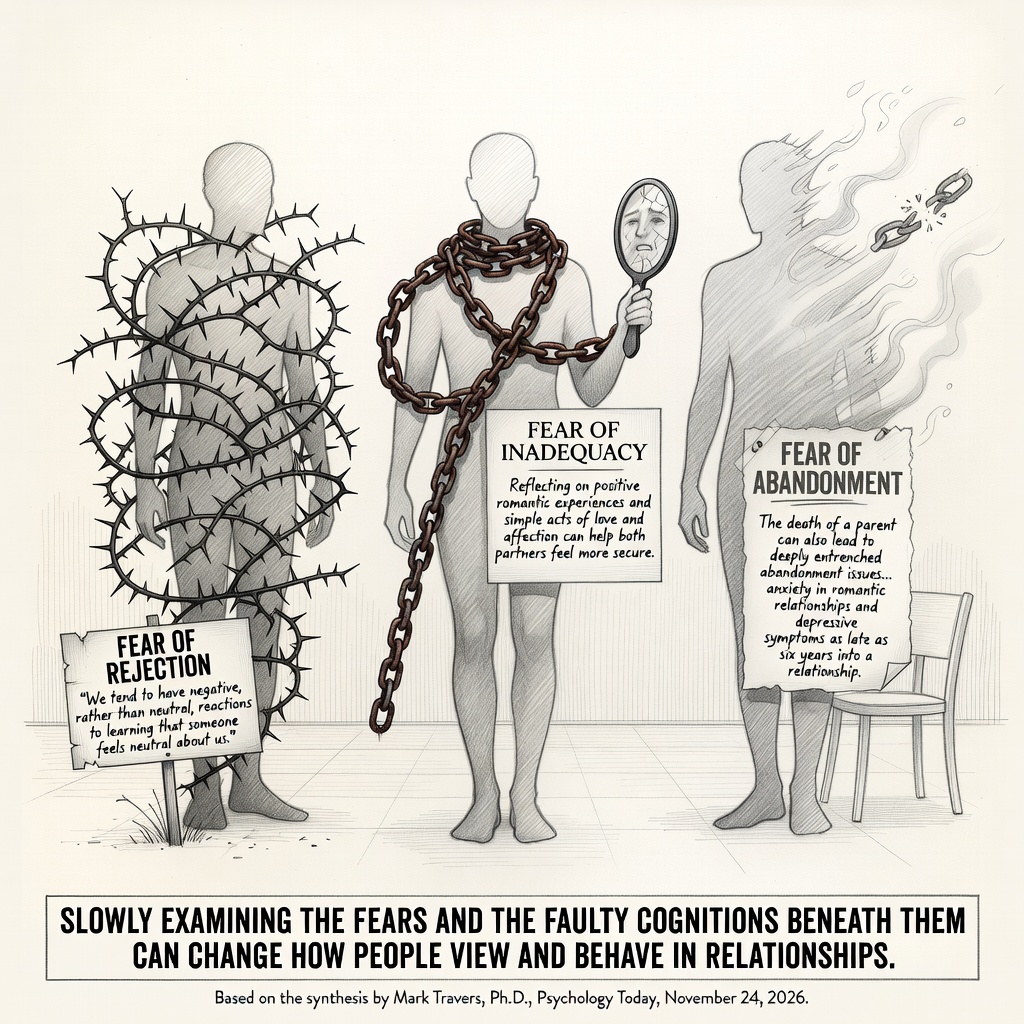
Fear of rejection can block relationships and may be linked to a deep worry about not being accepted or valued. It can appear as avoiding social situations, strong self-consciousness, or harsh self-criticism.
Psychologist Mark Leary, identified as the lead author of research on rejection, found that many people perceive more rejection than they actually experience. “We tend to have negative, rather than neutral, reactions to learning that someone feels neutral about us,” he explained. “What this means is that most people probably go through life feeling more rejected than they actually are.”
The post described an initial response as examining the evidence without automatically treating ambiguous or neutral cues as negative. It also pointed to self-regulation—the ability to identify and manage emotions and behaviors—as a way to question thoughts that feed fear and insecurity, including by looking for evidence for a belief and using more balanced self-talk.
Fear of inadequacy
A belief that one does not deserve a fulfilling relationship can involve constant comparison with other people or with a partner’s former partners, or a lasting sense of never being good enough.
A study published in the Journal of Personality and Social Psychology, described in the post as recent, suggested that reflecting on positive romantic experiences and simple acts of love and affection can help both partners feel more secure. The authors stated: “When jointly reminiscing about these positive experiences, partners can try to validate one another and the relationship. Telling how grateful they are for sharing the experience, disclosing positive emotions they felt during the experience or expressing how much they look forward to similar experiences in the future can be reassuring.”

Fear of abandonment
Fear of abandonment can be rooted in earlier experiences of feeling left behind or neglected, and can leave someone afraid of being alone or unloved. Emotional abandonment concerns may follow neglect by a parent, caregiver, or partner. Physical abandonment refers to an important person leaving abruptly, such as a parent’s departure during childhood.
A study published in the Journal of Youth and Adolescence was cited as explaining that the death of a parent can also lead to deeply entrenched abandonment issues, including anxiety in romantic relationships and depressive symptoms as late as six years into a relationship.
The post said people can begin by recognizing triggers, such as anxiety that rises during disagreements or fear of being replaced when a partner spends time with friends or does things independently. Acknowledging the fear was described as possibly the hardest step and, in the author’s view, the most useful one toward feeling more secure in close relationships.
Travers wrote that being driven by these fears is an unsatisfying way to live, while also saying there is no need to confront all of them at once. Slowly examining the fears and the faulty cognitions beneath them, he argued, can change how people view and behave in relationships.
The post synthesizes the author’s reading of the cited research. It does not report the studies’ methods, samples, or limitations, and it is not an individual assessment or a treatment plan.