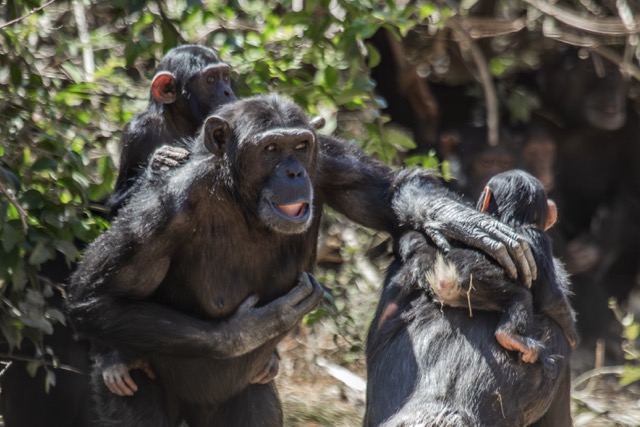
In an essay published on September 21, 2026, a researcher who studies chimpanzees in the field argues that popular “alpha male” messages aimed at young men conflict with evidence from primates, other animals, and human studies. The author writes that, across the Western world, young men and boys face an economy with fewer manual-labor and factory jobs that once gave many working-class men a sense of purpose. A profitable influencer industry, the essay says, has used social media to fill that gap with repeated messages such as “Reclaim your manhood,” “You are being feminized,” and “The world is making you soft,” while misframing evolutionary science. The author contends that every organism has to balance competition and cooperation, that cooperation does not diminish masculinity, and that male friendship—including affectionate touch, care, and vulnerability—underpins cooperation in many species.
Dominance is not only force
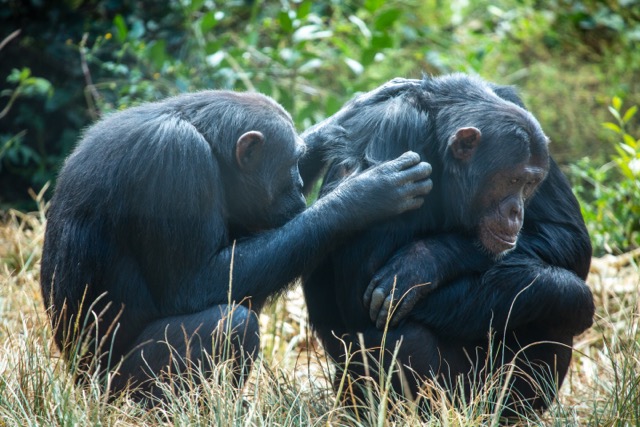
The essay says life coaches and politicians promote the idea of alpha males without accounting for how hierarchy works in nature. Male chimpanzees do form typically linear dominance relationships, compete, and sometimes fight, and higher-ranking males tend to sire more offspring. The author argues that those broad patterns leave out layered cooperation, nurturing touch, and care. Day to day, most competitive pressure never becomes a fight. Males groom one another for hours, embrace after conflicts, and kiss allies’ arms and shoulders before potential competition. Before risky boundary patrols, when they might meet rival groups, they hold one another’s genitals, which the author describes as a sign of deep trust.
Data spanning nearly three decades from Gombe, the essay reports, found that males with strong ties to the alpha sired more offspring than those without such ties. Males with wider networks of close allies also sired more offspring, whether or not they rose in rank. The author reads this as evidence that looking out for others, and contributing to a strong community, is associated with thriving.
At Taï National Park in Côte d’Ivoire, Anna Preis and colleagues measured urinary cortisol in wild males during stable and unstable dominance periods. The essay reports that this stress measure rose in every male during unstable periods, regardless of rank. Aggression moved the other way: it rose when conditions were calmer and the group faced less risk of destabilization. When the risk of escalation was greatest, males held back. The author notes that stability has its own payoff, because a group tearing itself apart cannot defend a territory.
The term “alpha,” the essay explains, grew out of mid-20th-century research on captive wolves placed together in crowded spaces with no room to escape—an arrangement the author says would produce a tense, despotic dynamic in any species, including humans. Once biologists studied wild wolf packs, those packs looked like families: a breeding pair and their grown offspring. L. David Mech, the biologist who popularized the alpha wolf, has spent more than two decades asking people to retire the term so it matches natural communities. The author says the idea still circulates on podcasts and social media despite that inaccuracy.
Reassurance before and after conflict
At a wildlife sanctuary in Zambia, the author describes a long-standing alpha male chimpanzee named Doug. During the author’s first field season, Doug was separated from the community for routine husbandry alongside a slightly younger rival and that rival’s paternal ally. The rival pair ambushed him. The author, who had known Doug as a composed leader, reports seeing him cowering and screaming. A low-ranking male Doug had rarely paid attention to approached first with a submissive gesture. What followed drew in most of the roughly 40 other chimpanzees. They embraced, touched, and kissed him; exchanged genital contact; placed their hands in his mouth; and invited him to mount them. The author says this scale of collective reassurance toward one individual was not seen again afterward and was likely sparked only by a genuine crisis. The essay describes the group’s response as comfort and what, to humans, would appear to be love.
The project’s main aim was to study consolation: how chimpanzees and their sister species, bonobos, comfort one another after fights. Researchers also kept noticing intense friendly contact when there had been no fight, often in anticipation of competition. To examine that, they ran a feeding task with a five-minute window before food arrived and filmed 116 apes across five groups at two sanctuaries. Apes that exchanged more reassuring contact beforehand went on to spend significantly more time feeding peacefully beside others. In chimpanzees, males showed most of this behavior, but primarily in Doug’s more tolerant group. In a more despotic group, where resources were less evenly distributed, male-male relationships were markedly weaker. The author suggests that friendship and reassurance among males helped these chimpanzees set competing interests aside and may lay groundwork for collective harmony.
Some of those contacts require unusual trust. Placing a finger, or a whole hand, inside another male’s mouth—or pressing one’s own mouth to someone’s body just after an attack—could be misread as aggression and start a new conflict. The essay notes chimpanzees’ reputation for amputating extremities and the size of their canines, which make the behavior exceptionally risky at turbulent moments. The researchers’ hypothesis is that the risk may be the point: that kind of vulnerability is offered only to someone trusted not to use it against the giver, and it signals something a show of strength cannot. The author reports that these behaviors were especially amplified in Doug’s group compared with a group led by a less benevolent alpha.
Doug remained alpha at the time of the essay. From the research, the author interprets that tenure as tied to the bonds Doug continued to invest in and the support he showed peers. The author also notes that Doug is flawed and sometimes lashes out, as any male chimpanzee might. Across the seven years of study, no challenge had displaced him. From work with many groups, the author writes that the most tolerant social environments seem to emerge under strong, stable, and generally fair alphas who allow others access to resources and keep tight bonds with their closest allies.
Touch, care, and human teams
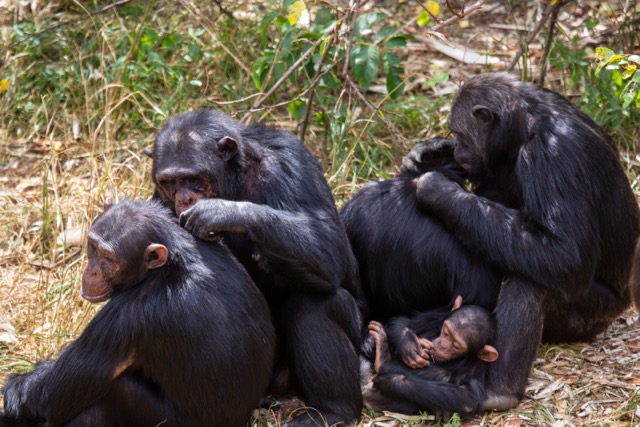
The essay also points to tenderness in other contexts. At Taï National Park, researchers recorded wild chimpanzees adopting orphaned infants; more than half were taken in by males with no obvious kinship reason to do so. One adult male, Porthos, adopted an unrelated infant female named Gia, carried her on his back for years, and shared food with her long after any potential social debt to her deceased mother had lapsed. Later analysis found that what predicted whether a male took on that role was not the infant’s sex and not relatedness, but the strength of the grooming bond he had shared with the mother before she died.
In humans, research across five European cultures found that the area of the body a person will let someone touch maps almost directly onto the strength of the emotional bond. There is cultural variation. The essay says British people are notably more guarded about casual contact than many European neighbors, and that touch between men carries particular social weight in many Western contexts. Touch can convey intimacy and trust, but holding a hand or shoulder can also be used to intimidate or harass. The author suggests learning from primates to stop withholding touch where it would help most, and to back off from it where it should not be used at all.
One setting the essay highlights is sport. A study of all 30 NBA teams during the 2008–09 season found that teams whose players touched more early in the season—through fist bumps, chest bumps, hugs, and high fives—later performed better and played more cooperatively, even after controls for player salaries and pre-season expectations. In women’s college basketball, players who received more physical contact from teammates after missing their first free throw were more likely to convert the second. After five straight shootout losses, England’s football governing body, the FA, spent 18 months rebuilding England’s penalty approach under Gareth Southgate, not only the technical side. Players were coached on how to treat one another after a miss, including placing an arm around a shoulder rather than leaving someone isolated. Celebrating after a scored kick became a deliberate way to steady whoever was next. The author says locker-room culture has never been shy about contact between teammates, and that the evidence suggests the contact might be doing real work.
The essay cautions that humans are exceptionally diverse in culture and behavior, for better and worse. It argues that calling human violence or cruelty “primal” or “animalistic,” while treating altruism as unique to humans, is unfair to other animals. The author notes that people have bullied others until those people took their own lives, wiped out entire tribes and cultures, and are removing protections for endangered keystone species that ecosystems depend on. The essay does not treat a drive to dominate as inevitable. If the apes show anything, the author writes, it is how much of that drive is managed and set aside day to day, and how much depends on the community. Humans still have to balance cooperative and competitive urges, and the author says the evidence suggests people sit toward the more cooperative end of that range more often than they might think.
What people expect, and where the author suggests starting
A study published in Science in June 2026, covering 125 countries and more than 100,000 people, found that 69 percent cooperated with a stranger when given the choice. Asked to guess, people put the share at 47 percent. That pessimism appeared in 124 of the 125 countries surveyed. The essay says this matters because people who expect others to cooperate are far more likely to cooperate themselves. When researchers simply told participants that most people worldwide see climate change as a threat, belief in others’ willingness to cooperate ticked up, and actual cooperation followed—slightly, but in the same direction.
The author frames the following as practical starting points, not as a tested program or a prescription. One main way primate cousins build affiliative relationships is by spending time in close proximity: grooming, playing, sitting in contact, or often just hanging out near close partners. The author suggests a car journey or a five-a-side game, and other activities in which nobody has to look anyone in the eye. If a friend is not much of a talker, doing something alongside him may get further than sitting him down and asking how he is doing. Great apes, the essay says, exchange most of their reassurance in the tense minutes before competition, not only in the aftermath. Reconciliation and comfort are common in humans and other primates, but the author argues that preventing escalation is easier than smoothing things over after a fight. The stated 22-point gap between how often people actually cooperate and what they think others will do is offered as a reason not to wait to be approached.
The author concludes that influencers who sell young men and boys a story of purely primal dominance run against the science and against what nature looks like in these studies. Force and competition are real parts of biology and have to be managed in everyday life. From years of studying humans’ closest relatives, the essay says, touch, care, cooperation, and even love appear to be among the most instinctive parts of primate social life.