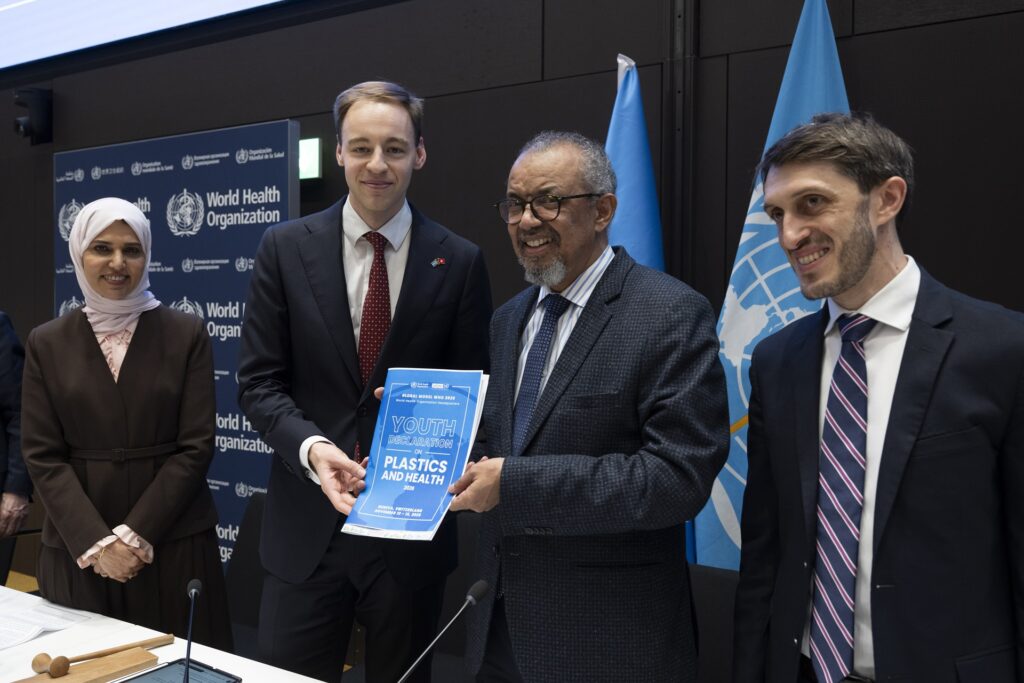
As reported on November 14, 2026 (UTC+8), more than 400 young people from over 50 countries and all six WHO regions had gathered in Geneva for the Global Model WHO. At the close of the November 10–13 event, delegates adopted a declaration calling for human health to be addressed in negotiations on a global plastics treaty.
The Global Model WHO Youth Declaration on Plastics and Health is a set of proposals, not an adopted treaty or a WHO policy. It is directed at two meetings scheduled for 2027: resumed plastics-treaty negotiations in March and the Eightieth World Health Assembly in May. Delegates said the August 2026 informal treaty text from the negotiations’ chair contained no article on health.
The declaration’s 11 calls to action include binding health obligations in the treaty, participation by health ministries in national delegations, and safeguards against conflicts of interest involving the plastics and petrochemical industries. Delegates also called for measurable targets to reduce plastic production, a phase-out of chemicals of concern, and standardized methods for measuring plastic chemicals and particles in the human body. Other proposals address safe waste management, protections for waste pickers, and limited, regularly reviewed exemptions for chemicals of concern in medical devices, beginning with products used by infants and pregnant people.
To explain their concerns, delegates pointed to figures indicating that more than 16,000 chemicals are used or found in plastics and that at least one in four is hazardous. They also cited the detection of plastic particles in human blood, brain tissue and amniotic fluid. Those findings do not, by themselves, establish the health effects of every detected particle or chemical.
Global Model WHO is a partnership between WHO and the World Federation of United Nations Associations. It simulates the World Health Assembly, giving young delegates a forum to debate global health issues and draft proposals.