
On November 23, 2026, KFF Health News reported that some patients received internet-connected knee implants they say they did not knowingly choose, while Medicare spending on remote monitoring had grown and evidence that the devices improve recovery remained limited.
Steve Russak, 70, of Santa Rosa Valley, California, woke from knee replacement surgery in 2025 to a text from the company that made his new knee. Over the next few days, Zimmer Biomet texted four times. He said he did not understand the messages asking him to use an app. A company representative then called and offered help setting up accessories. “I said, ‘What? I don’t know what you’re talking about,’” Russak told KFF Health News.
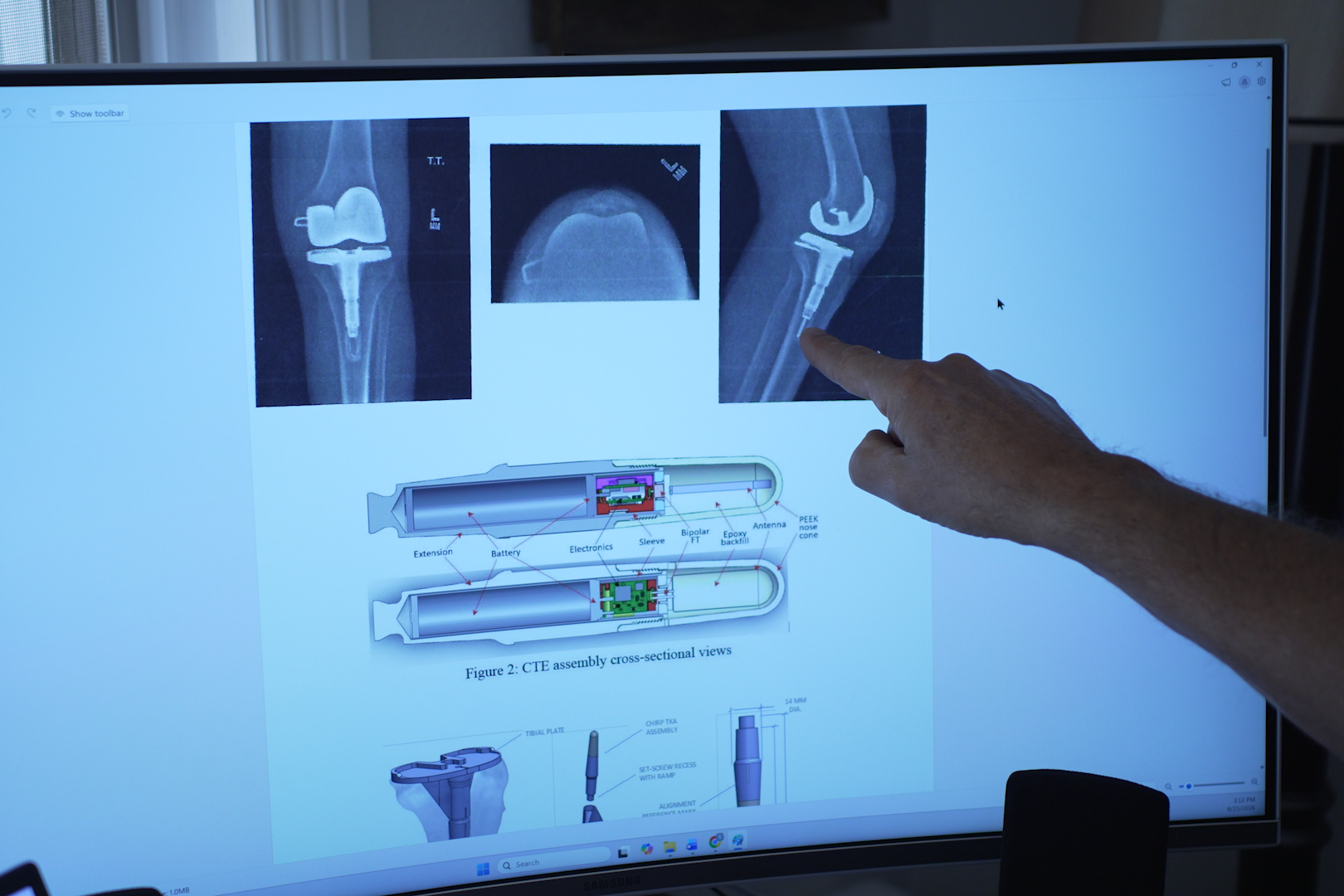
The implant was Zimmer Biomet’s Persona IQ, a “smart knee” with a lithium-ion battery, sensors, and a transmitter. If he authorized it, the device would send data on his gait and range of motion to his clinicians and to Zimmer. Zimmer introduced the Persona IQ in 2021 as “the world’s first and only” FDA-approved smart knee. The Indiana-based company also sells knee joints that are not connected to the internet.
What the lawsuits allege
Russak is suing his doctor, Zimmer, and Canary Medical, a health technology company that helped develop the device. In the lawsuit he claims the knee was an “unauthorized implantation.” He also claims that Zimmer’s “patient-facing materials” said he should have been given the option to opt out of data collection or to decline the knee, and that he was not. He said he does not want to turn on collection and transmission, in part because of privacy. He said that, with the device already in his body, it can also cause practical problems; he said he recently could not get an MRI because of compatibility issues. Those statements are his account, not a finding by a court or regulator.
Neither the doctor nor the doctor’s lawyer responded to multiple requests for comment. As of the November 23, 2026 report, the case was ongoing and the next hearing was scheduled for December 2026. Russak said he had dropped fraud and breach-of-fiduciary-duty allegations originally filed against the doctor, while continuing to sue on other grounds, including lack of informed consent. The doctor had not yet responded to the complaint in court.
Zimmer and Canary each filed initial responses denying “each and every allegation.” Their defenses include claims that any damages were another party’s fault or, in Zimmer’s wording, were caused by actions or reactions “not reasonably foreseeable.” Canary Medical did not respond to requests for comment.
Zimmer spokesperson Troy Kirkpatrick declined to comment on lawsuits against the company. He said “nearly 90%” of surveyed patients who received Zimmer joint replacements report they would again choose an orthopedic device with remote monitoring. That figure covers Zimmer joint replacements in the survey, not only the Persona IQ. “The transmission of post-operative recovery data requires patient authorization at the time the patient sets up an account and is designed to support patient-surgeon relationships and postoperative care,” Kirkpatrick said in an emailed statement. He added that Zimmer takes privacy and regulatory compliance “very seriously.”
Russak’s Medicare account showed the program paid for the surgery and the knee implant. It had not received claims for remote monitoring of the device, which he had not set up to transmit data.
In Contra Costa County, California, Jodi Murphy sued Zimmer, Canary Medical, and her doctor after receiving a Persona IQ and being registered for Zimmer’s app. The lawsuit alleges they acted “without disclosing this device or obtaining Plaintiff’s specific informed consent for its use.” The doctor and her practice denied all allegations. Zimmer’s attorneys have said the company “does not practice medicine and as a matter of law had no duty to obtain consent to the treatment provided by her physician.” A hearing was scheduled for February 2027. The doctor did not respond to requests for comment. Murphy and her lawyer declined to comment.
Russak’s lawsuit alleges his doctor told him the doctor “had not disclosed the electronic nature, wireless transmission functions, or data-collection capabilities of the Persona IQ to prior patients in whom he had implanted the same device.” The complaint cites that exchange as evidence the companies “failed to adequately educate” the doctor. “I don’t believe that Zimmer or Canary are training the doctors, and it’s an issue,” Russak told KFF Health News. That training claim is his allegation; the companies’ court filings denied the complaint’s allegations.
Zimmer’s website says the implant lets care teams “monitor and personalize” recovery and can make a practice more efficient, and that many patients prefer remote follow-up. Lower on the same page, the company says the implant is “not intended to support clinical decision-making” and has “not been shown to provide any clinical benefit.” The site also describes possible payments to surgeons who use the device, including ongoing fees for remote monitoring.
Remote monitoring payments
The knee sits inside a broader market of internet-connected products, from implants to external devices such as blood pressure monitors, that send condition data to clinicians. Proponents say the data can show, for example, whether a patient’s glucose is swerving out of control. The same report noted potential drawbacks, including privacy risks, and said some doctors and researchers caution that there is little evidence these products improve health outcomes.
“There is a lot of enthusiasm for remote monitoring technologies. There is tremendous potential,” said Sanket Dhruva, a University of California-San Francisco cardiologist and digital health researcher. He said the missing piece is rigorous evidence: “We’re getting all this data — is this helping our patients recover better? That’s what we really care about.”
Medicare and private insurers pay clinicians to review data from connected devices. In 2024, nearly 1 million Medicare beneficiaries received remote patient monitoring, according to the Department of Health and Human Services’ Office of Inspector General. Medicare, which covers older Americans and some people with disabilities, paid providers $536 million for that monitoring, more than double what it paid in 2021. A Peterson-KFF Health System Tracker review found that about 300,000 adults with employer-sponsored insurance had at least one remote-monitoring claim in 2023.
Medicare has proposed pulling back some of those payments after the inspector general warned of fraud risks. The watchdog reported that about 43% of patients who received remote monitoring in 2024 did not get the full set of services the program defines, including education about the device and review of the data for health changes. It also cautioned that companies sometimes cold-call patients and enroll them in devices they may not need. Those are program-level warnings, not findings about Russak’s or Murphy’s implants.
Connected devices can also affect insurance in ways patients do not expect. In 2018, ProPublica reported that insurers tracked use of CPAP machines and, after deciding some patients were not using them, denied coverage for replacement supplies such as masks.
Centers for Medicare & Medicaid Services spokesperson Christopher Krepich told KFF Health News that “CMS payment does not mean the agency endorses a manufacturer’s marketing claims or guarantees that a technology improves outcomes for every patient.” He said the agency regularly reviews its payment policies.
Zimmer sold some $3.3 billion in knee joints in 2025. It hired Arnold Schwarzenegger—a professional strongman, actor, and former California governor—to promote its products as “chief movement officer.”
Evidence and a lapsed add-on payment
Kevin Bozic, an orthopedic surgeon and chair of surgery and perioperative care at the University of Texas at Austin, reviewed Persona IQ research that Kirkpatrick supplied at KFF Health News’ request. “None of them compare Persona IQ to a more conventional [knee] implant,” he wrote. He said surgeons he knows are “ambivalent” and that many do not use the device. He called the implant “the most generic part of the operation” and said it “really doesn’t have a big impact at all on the outcome.”
In theory, he said, step counts and range-of-motion readings could flag a patient who is becoming more sedentary. In practice, he called that “a nice-to-have, certainly not a need-to-have,” and “certainly not something that I would want to add significant cost to the procedure for.” Surgeons already check on patients and ask to be told if their health changes, he said. “It’s overkill to have it in the knee.”
Smart-knee makers have also used a separate Medicare “new technology add-on payment,” which temporarily subsidizes new devices that would otherwise lose money and is meant to encourage innovation. The extra payment for the Persona IQ lapsed in fall 2024. From late 2020 until the government adjusted the benefit in 2026, a new technology did not have to substantially improve on older devices or drugs to qualify. A 2025 study found an average of four approvals a year in the near-decade before the 2020 change; the authors said that over the next four fiscal years the average rose to nearly 15 a year.
Dhruva, who studies digital technology and reimbursement, said the add-on can keep raising payments after the subsidy itself ends. Medicare rates are based on a procedure’s average cost. Because the add-on increases that cost, it can also increase the average used to set later rates. He said payment for services that are not well proven is also an issue in Medicare’s remote-monitoring benefit. He said there is little evidence on the value of remote monitoring in general, or of smart knees in particular, even as taxpayers have subsidized them. “In general, the field is in need of much more rigorous data.”
Privacy and consent
Kate Black, a health-data privacy lawyer who is not involved in the Russak or Murphy cases, said these products handle “quite a bit of data,” and that disputes often turn on patients “not understanding the information collection, use, and disclosure.” She said consent standards for an implanted knee “should be quite high” because, unlike a wearable, the device stays in the body for years.
“Every step you take, they know every step you take,” Russak said.
Zimmer’s own description says the Persona IQ has not been shown to provide a clinical benefit and is not intended to guide clinical decisions. The November 23, 2026 reporting treated the lawsuits as pending allegations. Zimmer and Canary had denied the claims against them; Murphy’s doctor and practice had denied hers; Russak’s doctor had not yet answered the complaint.